Showing posts with label hematology. Show all posts

Thursday, March 2, 2017

Sickle cell disease: latest news of a possible cure?

BBC news reports that a Paris teenager with Sickle cell disease, treated by genetic manipulation (using a virus) seems to be okay and well two years later.

Is this a possible cure?
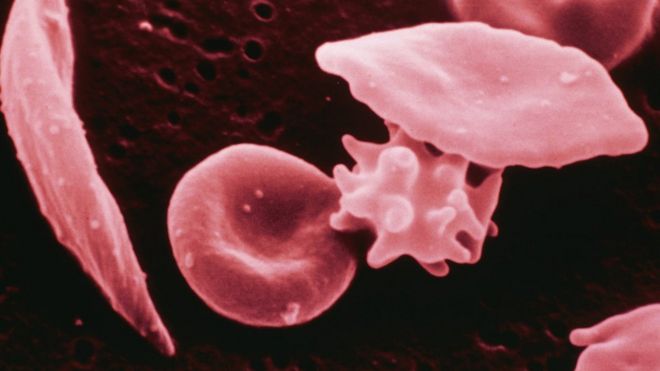
Healthy red blood cells are round, but the genetic defect makes them sickle shaped,
Photo credit: SPL.
Medscape article here:


Hydroxyurea, which stimulates fetal hemoglobin production, is the only disease-modifying therapy for SCD; allogeneic hematopoietic stem cell transplant is curative. Fewer than 18% of people with severe SCD find transplant matches. For them, autologous transplant with a corrected beta globin gene — gene therapy — is a tantalizing chance at a possibly one-time treatment. 

 Jean-Antoine Ribeil, MD, PhD, from the Reference Centre for Sickle Cell Disease, Necker Children's Hospital, Paris, France, and colleagues introduced a lentiviral vector bearing an antisickling variant of HbA into a boy when he was 13 years old. The patient "had complete clinical remission with correction of hemolysis and biologic hallmarks of the disease," they write.

in plain English, when the body is stressed, the red blood cells change shape to a "C"... these cells then can't get through the small tiny blood vessels. Then the low oxygen in the areas where they clog up circulation gets lower in oxygen, causing more and more cells to change shape and block circulation.

Hydroyurea cuts down this as does aggressive treatment of infections (antibiotics) and stopping dehydration when sick.

Several cures have been proposed: Bone marrow transplants of the stem cells that make blood would work, but it has a lot of risks/side effects, and you need a good donor match.

This treatmen uses a virus to snip in a new piece of DNA to fix the problem.

Gizmodo has a ong article here about possible treatments.

Sickle cell disease affects about 100,000 people in the US, most of whom are black. It is an inherited genetic disease caused by a mutation of a single letter in a person’s genetic code.
This single-letter mutation makes it a promising candidate for cutting edge technologies, like the gene-editing technique CRISPR-Cas9, and other gene therapies. Recently, a rush of new research has sought to address it. Two other gene therapy studies for sickle cell are underway in the US —one at UCLA and another at Cincinnati Children’s Hospital. Yet another is about to start in a collaboration between Harvard and Boston Children’s Hospital. Last fall, researchers all demonstrated the ability to correct the mutation in human cells using CRISPR, though that strategy will yet have to surpass significant scientific and political hurdles before reaching clinical trials.
In the new study, researchers took bone marrow stem cells from the boy and fed them corrected versions of a gene that codes for beta-globin, a protein that helps produce normal hemoglobin. The hope was that those altered stem cells would interfere with the boy’s faulty proteins and allow his red blood cells to function normally. They continued the transfusions until the transplanted cells began to produce normal-shaped hemoglobin. In the following months, the numbers of those cells continued to increase until in December 2016, they accounted for more than half the red blood cells in his body. In other words, so far so good.

Tuesday, December 13, 2016

Orange Babies and blue men

I had written a previous post about the Rose Madder herb being fed to horses to make their hooves pink.

That is not the only dye/foodstuff that can change the colour of skin or nails:


Wholesome baby food website discusses the question: Why is my baby orange.

Image: keeleymorris on Twitter

Carotenemia is a medical term for a condition that causes the skin to turn orange-ish due to increased blood carotene levels. In the vast majority of cases seen, it is associated with large consumption of carotene in the diet; as in too many carrots or sweet potatoes. Read more at http://wholesomebabyfood.momtastic.com/orangebaby.htm#1kHfjLYwFgte6T66.99


more at Wikipedia 

we see this a lot in kids, and the way you can tell it's not jaundice is that their eyes are not yellow. The treatment is to reassure the parents.

I've only seen it once in an adult: It she admitted that she had a craving for carrots.

People who are anemic often have similar cravings: although ice eating and starch/clay eating are more common. (The technical term for this is pica).

I tested her, and sure enough, she was anemic and low in iron.

but carrots are not the only food that can cause problems: tomatoes can do it also, from the lycopene in them.


argyria is from silver in the skin (benign). One of the problems for "preppers" who use AgNO3 for medical problems.


and Iron overload (from a genetic defect, hemochromatosis or from being given too much iron for severe anemias,) can also discolor the skin.

It's not hemochromatosis per se, but there is a well known problem of dark black skin in Bantus in Africa.

We saw a lot of very dark skin in our heavy native-beer drinkers in Africa: it is because the local beer is brewed in iron kettles, but also because some people carry a gene that makes them vulnerable to the condition.


WIKIPEDIA link

Dietary iron overload is the consumption of large amount of home-brewed beer with high amount of iron content in it. Preparing beer in iron pots or drums results in high iron content. The iron content in home-brewed beer is around 46–82 mg/l compared to 0.5 mg/l in commercial beer


we didn't treat it as such (often these patients also had cirrhosis from alcohol, and/or viatmin B deficiency, so mainly we would feed them up and tell them to stop drinking).

The Wikipedia article also suggests this might be behind the high rate of liver cancer in Africa, but I have also read that mold in certain foods might be another reason for this, or maybe Hepatitis C.

finally, there was a book of medical mysteries that included a story about 11 blue men.

usually when patients are blue, it is due to lack of oxygen from heart or lung problems.

For example: we docs separate lung disease in smokers into pink puffers (pure emphyesema) and blue bloaters (Chronic Bronchitis...Bloaters is British slang for a person who coughs up lots of phelgm). Because the mucus causes CO2 retention, they tend to have a high CO2 level and tend to be a bit cyanotic.(blue)

https://goo.gl/images/chzgxA

But the classic story "11 Blue Men", this was due  someone accidentally putting sodium nitrate into salt shaker.

Full story HERE

quite a few medicines can cause methhemoglobinemia, but most of these medicines are used in doses too small to cause problems unless you overdose, or unless have a genetic problem. this long medical article discusses the problem.

and then there is a rare congenital form of methhemoglobinemia that runs in families... one example is the Blue Fugates of Kentucky.


------a shorter version is on my FKCLINIC blog.